Biomimetic nuclear pore complexes
A healthy nucleus is critical to the normal function of eukaryotic cells. The nucleus is a membrane-bound organelle responsible for a plethora of cellular processes, including DNA compartmentalisation, growth, division, and metabolism. Therefore, it must maintain rapid, precisely controlled communication between the internal nucleoplasm and external cytoplasm. This communication is established through a large protein assembly, the Nuclear Pore Complex (NPC) (Wente & Rout, 2010).
Comprising structural proteins arranged around a central channel, the NPC transports up to a thousand nuclear cargoes — RNAs, genome-maintenance proteins, and other macromolecules — across the nuclear envelope every second. The NPC is highly selective; small cargoes (below ~5 nm) pass freely by passive diffusion, while larger molecules are excluded unless bound to Nuclear Transport Receptors (NTRs) (Timney et al., 2016). Selectivity comes from intrinsically disordered proteins rich in phenylalanine-glycine repeats, known as FG-Nucleoporins (FG-Nups). FG-Nups form a dynamic barrier within the pore that excludes most macromolecules. NTRs interact directly with the FG repeats via hydrophobic interactions, lowering the energetic cost of translocation (Frey & Görlich, 2007).
Electron microscopy has resolved the NPC’s structural scaffold to near-atomic detail. Despite this, the organisation of FG-Nups, and the mechanism by which they block non-NTR-bound cargo, remains poorly understood (Beck & Hurt, 2017). These questions are being investigated from many angles, including in-vitro reconstitution (Figure 1). Historically, our lab has approached the problem by building biomimetic NPCs using nanotechnology. Minimal, engineered systems allow the underlying biophysics of selectivity to be directly probed, advancing understanding toward the more complex native nuclear pore.
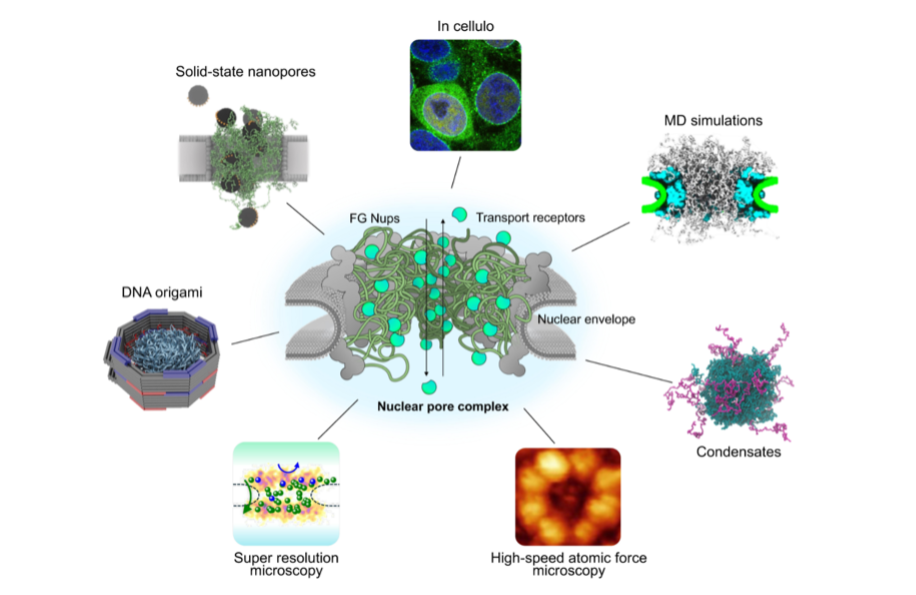
Figure 1: A schematic of the NPC structure, with structural proteins creating a central channel to which FG-Nups are tethered. Bidirectional transport of cargo is indicated. Current methods used to investigate NPC transport phenomena are also illustrated. The Dekker lab focuses on solid-state nanopores and DNA origami approaches. Figure from (Baumann et al., 2025).
Solid State NPC Mimics Enable Direct Measurements of Transport
In 2011, our lab created the first biomimetic NPC, by drilling a single nanoscopic hole in a silicon-nitride membrane and covalently attaching FG-Nups within (Kowalczyk et al., 2011). The NPC mimic recreated the selectivity of native NPCs, allowing ionic current measurements to record individual cargo translocation events with sub-millisecond temporal resolution (figure 2). Studies revealed that pore diameter governs FG-Nup barrier behaviour (Klughammer et al., 2024). Solid-state nanopores, combined with current measurements and TEM imaging, remain a core platform for reference studies that inform models of the native NPC.
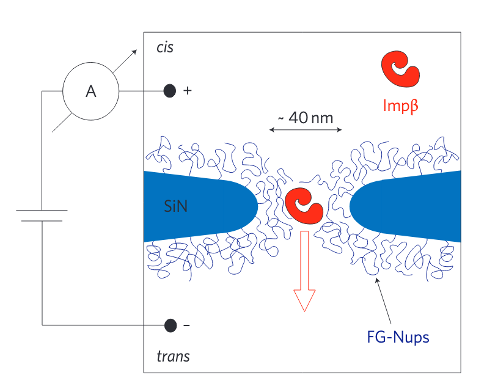
Figure 2: Schematic of a solid-state biomimetic NPC. A single nanopore is drilled into a Silicon-Nitride (Si-N) membrane. FG-Nups are tethered to the Si-N, and nuclear cargos (here, importin β) are transported selectively. Individual translocation events are recorded as blockades in ionic current across the pore. Figure from (Kowalczyk et al., 2011).
DNA Origami NPC Mimics Enable Precise Spatial Control
DNA origami is a well-established nanofabrication technique, which exploits the natural complementary base-pairing of DNA to fold complex structures from single nucleotide strands. In 2018, following several years of collaboration with the Dietz group in Münich, our lab created the first DNA origami biomimetic NPC: a ring-shaped structure with an internal diameter of ~30 nm (Figure 3), and individual FG-Nups grafted to precise locations within the central channel (Ketterer et al., 2018). The precise control of both pore geometry and FG-Nup location allowed the first studies of how FG-Nup spatial arrangement affects transport (Ananth et al., 2018) (Fragasso, De Franceschi, et al., 2021). Engineering of these origami structures continues, building more complex mimics that better recreate the behaviour of the native NPC.
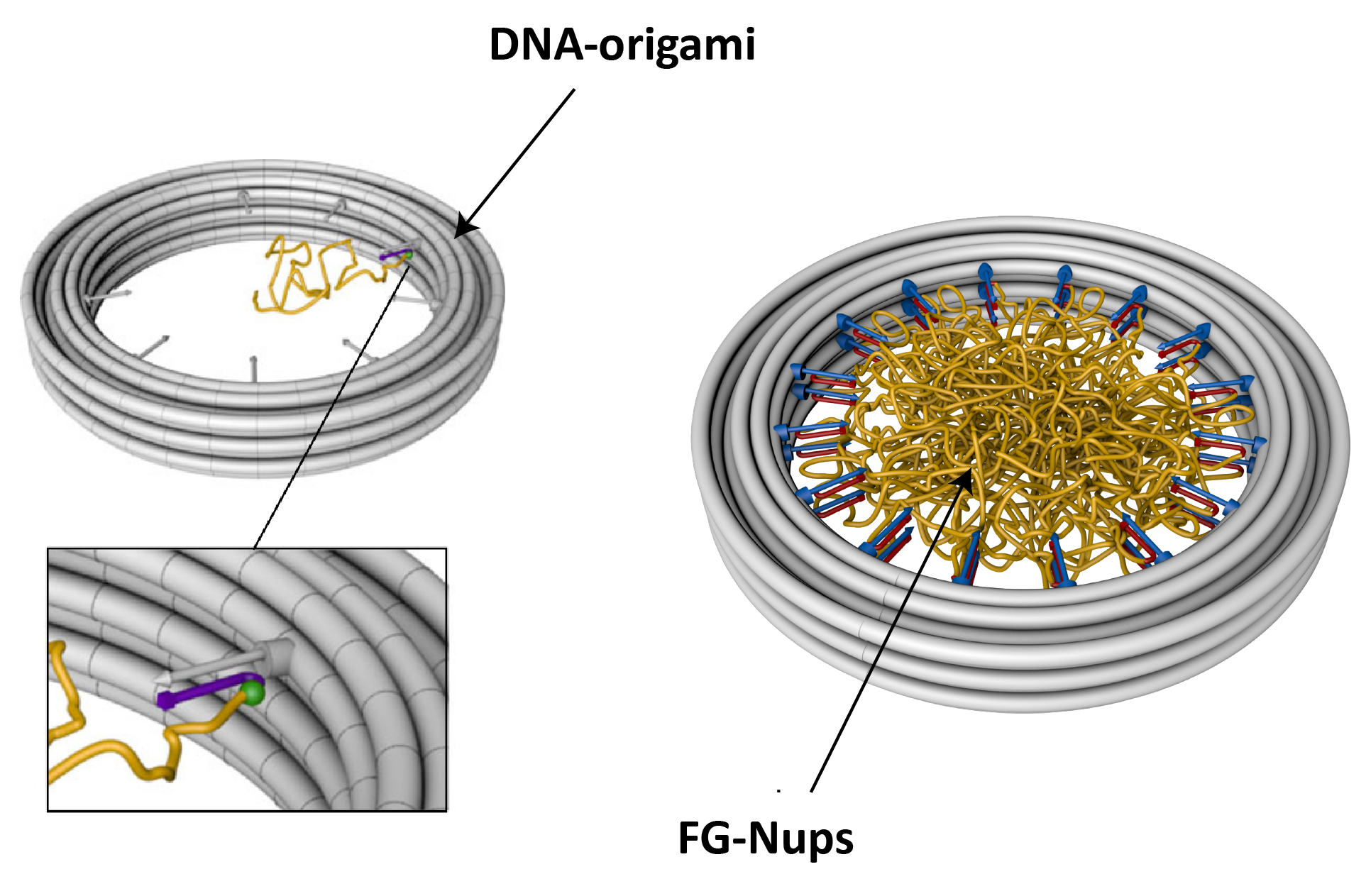
Figure 3: A schematic of a DNA origami biomimetic NPC. Long single-stranded DNA has been folded into a cylindrical structure. FG-Nups are covalently bonded to oligo ‘handles’ inside the pore, thus controlling the spatial distribution of FG-Nups within the NPC. Figure from (Ketterer et al., 2018).
Designer FG-Nups Provide a Minimalistic System for Nuclear Selectivity
Consistent with the biomimetic approach, our lab (in collaboration with the Onck group in Groningen) designed synthetic FG-Nups (Fragasso, De Vries, et al., 2021). These rationally designed structures controlled FG repeat spacing and charge distribution. Studies of designer FG-Nups in biomimetic nanopores reproduced the selectivity observed in native NPCs, allowing fast transport of NTR-bound cargo and excluding non-specific cargo. The artificial FG-Nups constitute a fully designed system, providing a direct test of which features are necessary for selective transport.
We continue our research on resolving the mechanism of transport through the nuclear pore complex, using single-molecule techniques on biomimetic NPCs.
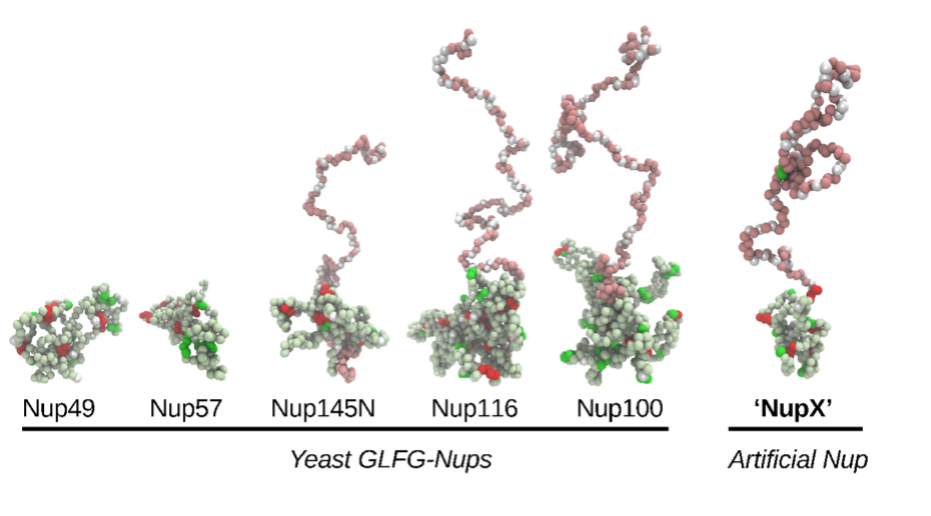
Figure 4: Snapshots of different simulated FG-Nups. Nup49, Nup57, Nup145N, Nup116 and Nup100 illustrate varying conformations that FG-Nups with different functions can assume. NupX is designed with a conformation more similar to Nup116 and Nup100. Studies with NupX were able to reproduce the selective behaviour of native FG-Nups. Figure from (Fragasso, De Vries, et al., 2021).