Protein dynamics with nanopores
Proteins are the primary functional molecules of life, orchestrating virtually all biological processes, from intracellular signaling and metabolism to immune responses and disease progression. Traditional methods primarily yield sequences (mass spectroscopy) and static snapshots of protein structures (x-ray crystallography and cryo-TEM), leaving their dynamic roles in biological function largely unexplored. To elucidate the molecular mechanisms of these essential nanomachines, strategies have been developed to trap and monitor individual proteins over extended periods.
Recently, our group developed a Nanopore Electro-Osmotic Trap (NEOTrap), which enables the trapping and observation of single proteins for hours with sub-millisecond temporal resolution. The NEOTrap provides the resolution necessary to distinguish proteins of varying sizes and shapes, as well as to discriminate between nucleotide-dependent protein conformations. Given its experimental simplicity and capacity, the NEOTrap opens new avenues for label-free single-protein study.
We constructed the NEOTrap by docking a custom-designed DNA origami sphere into a SiN-based solid-state nanopore coated with lipid bilayer. Upon applying an electric field, electrophoretic forces drive the DNA origami sphere onto the nanopore and lead to a pore blockade (Fig. 1i). Under applied electric field, cations screening DNA origami migrate toward the cathode, generating electro-osmotic flow (EOF, Fig. 1ii). The resulting EOF drives proteins into the nanopore cavity and traps them there for extended periods while resulting in a reduced ionic current flow, depending on their size, mass, and conformation (Fig 1iii).
We tested the ability of NEOTrap to distinguish proteins based on their size and shape, as different molecular dimensions yield distinct current blockade levels. More importantly, it enables the discrimination of different conformational states within the same protein species: we successfully resolved distinct conformational states and dynamic transitions of Hsp90 in the presence of various nucleotides (, , ) or in their absence.
Our current efforts are now focused on leveraging this platform for protein fingerprinting, detecting post-translational modifications (PTMs), and tracking protein conformational changes during enzymatic reactions. Moreover, we also aim to develop lipid-embedded version of the DNA origami trap the LEOtrap) to get better control over pore size and architecture.
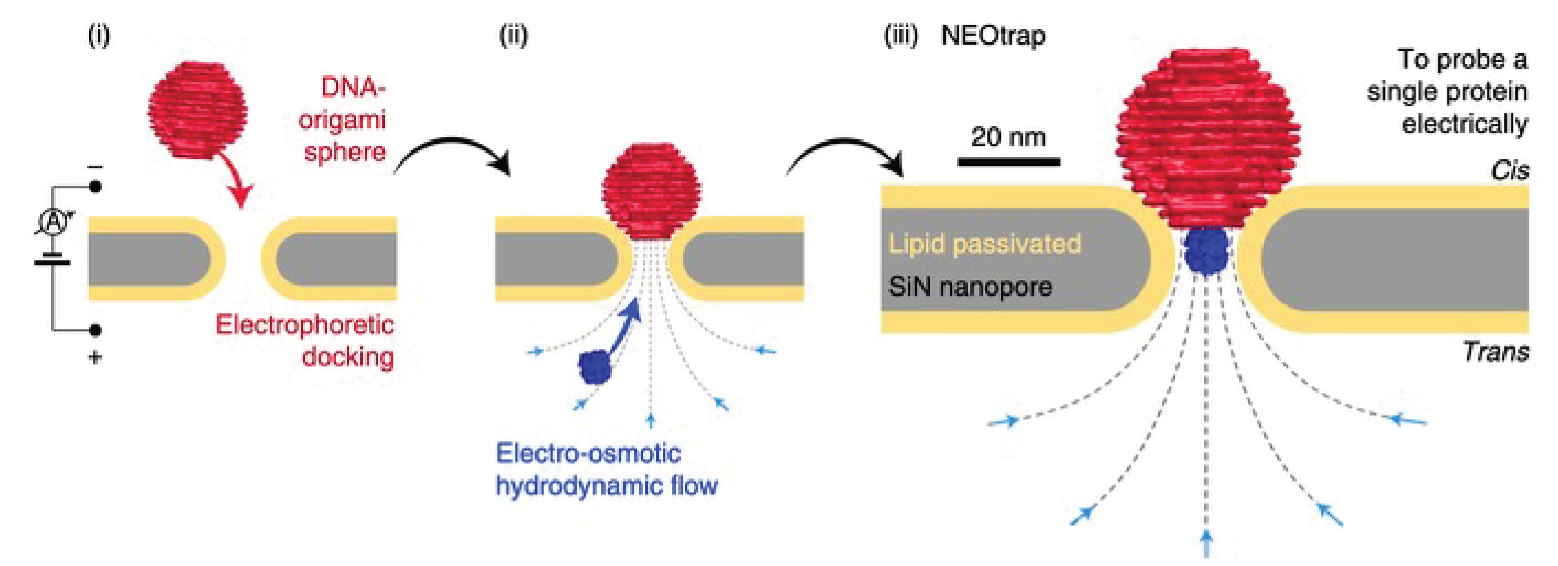
Working principles of NEOTrap